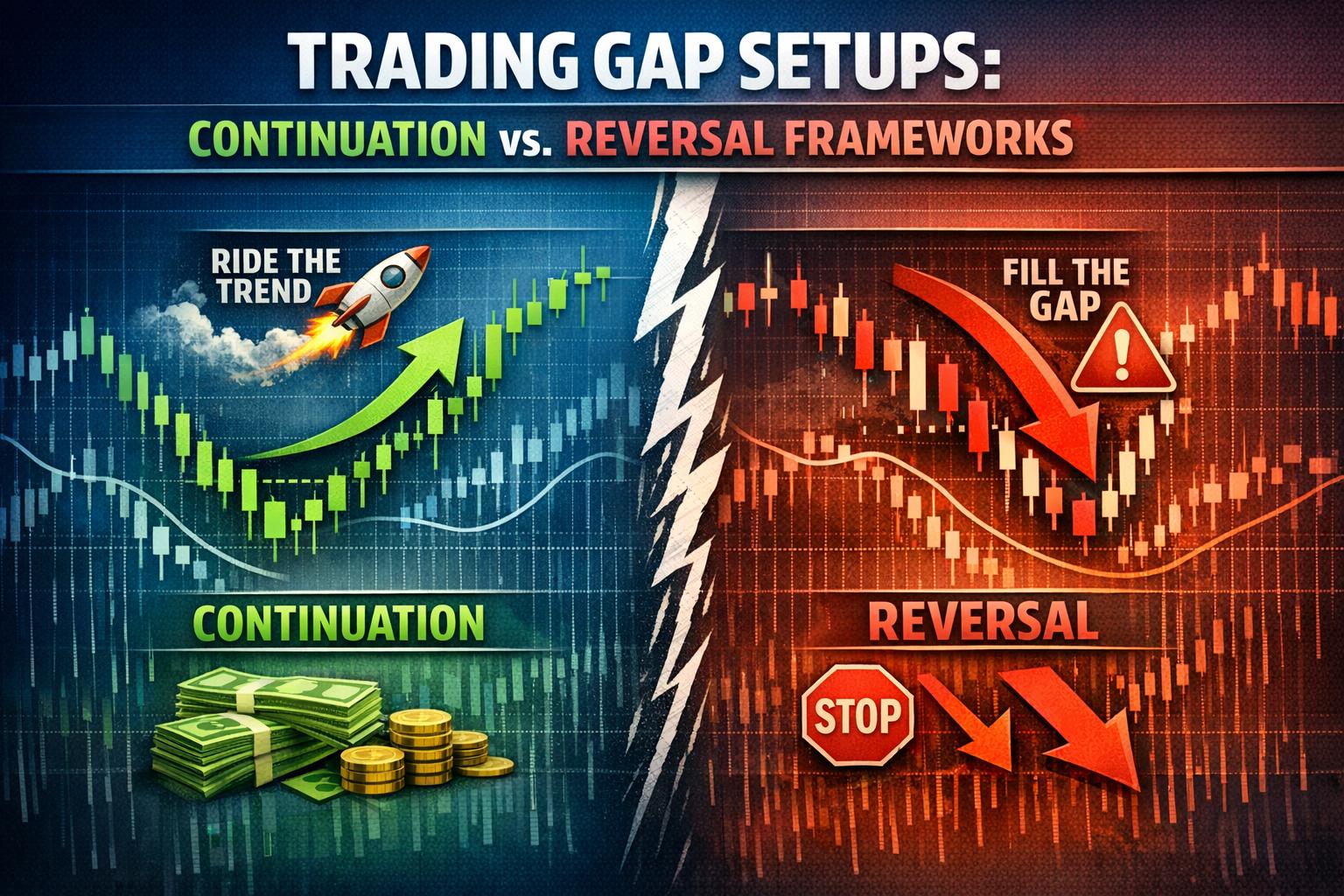
Trading Gap Setups: Continuation vs. Reversal Frameworks
Understanding Trading Gaps
Trading gaps are areas on a price chart where an asset’s price moves sharply from one level to another with little or no trading activity occurring between those levels. On a standard candlestick or bar chart, this phenomenon appears as a visible blank space between the closing price of one period and the opening price of the next. Gaps are most frequently observed on daily charts, where news releases, earnings reports, macroeconomic announcements, or geopolitical developments occur outside regular trading hours and influence the next session’s opening price.
From a structural perspective, a trading gap represents a sudden imbalance between supply and demand. When buyers are significantly more aggressive than sellers, price may open significantly higher than the prior close. Conversely, when selling pressure dominates, the opening price may be substantially lower. Because no transactions occur within the gap range, these levels often gain technical significance in future price action.
Trading gaps are often categorized into two primary frameworks: continuation gaps and reversal gaps. While other classifications exist—such as common gaps and breakaway gaps—continuation and reversal frameworks provide a practical structure for interpreting whether a gap suggests persistence of a trend or a potential change in direction.
The Mechanics Behind Trading Gaps
To understand the practical implications of trading gaps, it is necessary to examine how they form. Most gaps occur due to information asymmetry between trading sessions. During non-trading hours, new information may materially alter market expectations. Because regular market participants are unable to transact during this time, orders accumulate for the next session. When trading resumes, the influx of buy or sell orders can cause the opening price to adjust significantly, creating a gap.
In equities markets, earnings reports are a common catalyst. If a company reports stronger-than-expected earnings after the market closes, buy orders may overwhelm sell orders the next morning, resulting in a gap up. In futures or foreign exchange markets, macroeconomic announcements often produce similar effects, though around-the-clock trading may reduce the frequency or size of gaps compared to equities.
Market structure also contributes to gap formation. Limit orders placed outside the prior trading range can influence the opening auction process. If liquidity within certain price levels is thin, even a moderate imbalance can lead to a substantial price shift. Therefore, analyzing a gap requires more than simply noting its existence; one must consider market liquidity, timing, and external catalysts.
Continuation Gap Frameworks
A continuation gap, also referred to as a runaway or measuring gap, occurs during an established trend and suggests that the prevailing directional movement is likely to persist. These gaps typically emerge after the trend has already demonstrated strength, often following a consolidation phase or brief pullback. Their appearance signals renewed participation aligned with the dominant direction.
Continuation gaps frequently occur in the middle stages of a trend rather than at its beginning or end. In many cases, the gap represents an acceleration phase in which participants who previously hesitated decide to enter positions in line with the prevailing movement. This influx of additional participation adds momentum to the existing trend.
An important characteristic of continuation gaps is their relative persistence. Prices may not immediately return to fill the gap area. Instead, the market continues to move in the direction of the gap, using it as a structural support level in an uptrend or resistance level in a downtrend.
Identifying Continuation Gaps
Correctly distinguishing a continuation gap from other types of gaps requires analysis of trend structure and trading volume. A continuation gap typically occurs after a clearly defined sequence of higher highs and higher lows in an uptrend, or lower highs and lower lows in a downtrend. The broader context of sustained directional movement is essential.
Volume analysis provides additional confirmation. Continuation gaps are often accompanied by elevated trading volume relative to recent sessions. Increased volume suggests participation from institutional investors or large market participants, reinforcing the strength of the prevailing trend. If a gap occurs on weak or declining volume, its classification as a continuation signal becomes less reliable.
Another identifying feature is the market’s behavior immediately following the gap. In a continuation framework, price tends to move further in the direction of the gap within subsequent sessions, with limited retracement into the gap area. Minor pullbacks may occur, but the bulk of the gap typically remains unfilled during the short term.
Technical indicators can support identification. Moving averages sloping in the direction of the trend, momentum oscillators showing sustained strength, and expanding price ranges all reinforce the interpretation that a gap represents continuation rather than exhaustion.
Strategies for Trading Continuation Gaps
Trading continuation gaps involves aligning positions with the dominant trend. Many traders wait for confirmation that the gap is not immediately reversed before entering a position. This confirmation may come in the form of a strong close near the high of the session for a bullish gap or near the low for a bearish gap.
One approach involves entering a trade after a minor retracement toward the upper portion of the gap in an uptrend. If price respects the gap boundary as support and resumes upward movement, it suggests that the market acknowledges the gap’s significance. Stop-loss levels are often placed below the lower boundary of the gap to limit risk in case of misclassification.
In trending markets, continuation gaps can also serve as measuring tools. Some traders estimate potential price targets by projecting a distance similar to the trend segment preceding the gap. While not precise, this method provides a structured framework for setting expectations.
Risk management remains critical. Even in strong trends, sudden macroeconomic developments or unexpected news can invalidate the continuation thesis. Position sizing and predefined exit criteria help mitigate exposure to unforeseen reversals.
Reversal Gap Frameworks
In contrast to continuation gaps, a reversal gap, sometimes called an exhaustion gap, signals that the prevailing trend may be approaching its endpoint. These gaps typically occur after an extended directional movement, when participation may be at elevated levels and incremental new buying or selling becomes limited.
Reversal gaps often reflect a final surge of participants entering in the direction of the established trend. In an uptrend, this may manifest as an aggressive gap higher driven by late entrants reacting to recent gains. However, instead of sustaining the upward movement, the price fails to hold above the gap and begins to weaken. This behavior suggests that demand may have reached a saturation point.
Because reversal gaps tend to occur near the end of a trend, they are frequently associated with overextended technical conditions. Oscillator indicators may show divergence, while price may be significantly above long-term averages in an uptrend or below them in a downtrend.
Identifying Reversal Gaps
Identifying a reversal gap requires attention to both trend maturity and post-gap behavior. Unlike continuation gaps, reversal gaps often show limited follow-through in the direction of the gap. For example, after a bullish gap in a late-stage uptrend, the market may stall or produce a bearish reversal pattern within the same session or shortly thereafter.
Volume patterns may differ from those of continuation gaps. A reversal gap can occur on high volume, reflecting a final burst of trading activity, or on declining volume, indicating reduced conviction. In either case, what distinguishes the reversal gap is the subsequent inability of price to maintain its new level.
A defining characteristic is the tendency for reversal gaps to fill quickly. When price retraces into the gap and closes it within a short period, it suggests that the initial imbalance between supply and demand has been corrected. Once the gap is filled, further movement often extends in the opposite direction of the original gap.
Confirmation frequently requires additional technical evidence, such as breakdowns below established support levels in the case of a bearish reversal or breakouts above resistance in the case of a bullish reversal after a downward gap. Candlestick patterns, including engulfing formations or long upper or lower shadows, can provide supplementary clues.
Strategies for Trading Reversal Gaps
Strategies for reversal gaps typically involve preparing to trade against the prior trend once sufficient confirmation appears. Because attempting to anticipate a reversal prematurely can result in losses, many traders wait for clear evidence that the gap has failed.
A common method involves monitoring whether price holds beyond the gap boundary. If the market closes back inside the prior trading range, it may indicate that the gap lacks structural support. In such cases, traders may initiate short positions after a bullish exhaustion gap or long positions after a bearish exhaustion gap.
Stop-loss placement in reversal trades is often positioned beyond the extreme of the gap day, providing protection if the market resumes its initial direction. As with continuation strategies, risk control is fundamental, given the inherent uncertainty around trend changes.
Profit targets may be based on prior support and resistance levels, retracement measurements, or volatility-based calculations. Because reversals can evolve into broader trend changes, some traders scale out of positions gradually while maintaining a portion to capture extended movement.
Evaluating Gap Context and Supporting Factors
While classification into continuation or reversal categories offers a structured framework, effective gap analysis depends heavily on context. Volume behavior remains one of the most informative supporting factors. Elevated volume accompanying a gap suggests strong conviction, but its interpretation depends on trend location and subsequent price behavior.
Historical price patterns also provide guidance. Reviewing past instances in which the same asset produced gaps under similar conditions can reveal tendencies toward continuation or reversion. Some securities regularly fill gaps, while others sustain prolonged movements without retracement.
Market conditions at the macro level influence gap behavior. During periods of high volatility or major economic transitions, gaps may occur more frequently and exhibit larger magnitudes. In stable environments, gaps may be smaller and more susceptible to prompt filling. Interest rate announcements, employment reports, and geopolitical developments frequently alter gap dynamics across asset classes.
Time frame considerations are equally important. A gap visible on a daily chart may appear insignificant on a weekly chart or highly pronounced on an intraday chart. Multi-time-frame analysis helps ensure that gaps are interpreted within an appropriate structural perspective. For instance, a daily continuation gap may simply represent a minor fluctuation within a larger weekly consolidation.
Liquidity also affects gap persistence. Highly liquid securities often experience faster gap fills due to the presence of numerous active participants. Thinly traded assets, by contrast, may retain unfilled gaps for extended periods because limited counterparty interest reduces corrective trading pressure.
Gap Filling and Market Psychology
The concept of “gap filling” refers to price returning to trade within the gap range. While not all gaps fill, many eventually do. This phenomenon can be understood through market psychology and positioning. Traders who missed the initial move may view the open gap area as a reference point for entry, while those who entered during the gap may use it for exits or stop placements.
In continuation scenarios, unfilled gaps can become reinforcement zones. In uptrends, the lower boundary of the gap may function as support, as buyers step in to defend the new price range. In downtrends, the upper boundary may operate as resistance.
In reversal contexts, rapid filling of a gap reflects the market’s reassessment of initial reactions. When price quickly returns to prior levels, it indicates that the imbalance driving the gap was temporary rather than structural.
Integrating Gaps into Broader Trading Systems
Trading gaps should not be evaluated in isolation. Integrating gap analysis into a comprehensive trading system improves reliability. Trend identification tools, volatility measures, and support and resistance mapping provide additional context.
Risk management practices must remain consistent regardless of gap type. Because gaps involve abrupt price changes, slippage can occur, particularly when entering at the open. Predefined risk parameters and use of appropriate order types help manage execution challenges.
Backtesting gap-based strategies on historical data can reveal statistical tendencies specific to a chosen asset class or market environment. However, past performance does not guarantee future outcomes, and periodic reassessment of strategy effectiveness is necessary.
Conclusion
Trading gaps represent significant shifts in price that occur when supply and demand imbalances develop between trading sessions or within volatile intraday conditions. By categorizing gaps into continuation and reversal frameworks, traders gain a structured method for interpreting whether a gap indicates trend persistence or potential change.
Continuation gaps typically emerge during established trends, are supported by strong participation, and show limited immediate retracement. Reversal gaps often occur near trend exhaustion, demonstrate weak follow-through, and frequently fill quickly before a directional shift.
Comprehensive evaluation requires analysis of volume, historical behavior, broader market conditions, liquidity characteristics, and multi-time-frame context. When integrated into disciplined trading systems with appropriate risk management, gap analysis can contribute to informed decision-making and structured trade planning.
This article was last updated on: April 25, 2026