Scaling Into and Out of Trades: Methods and Mistakes
Understanding Scaling in Trading
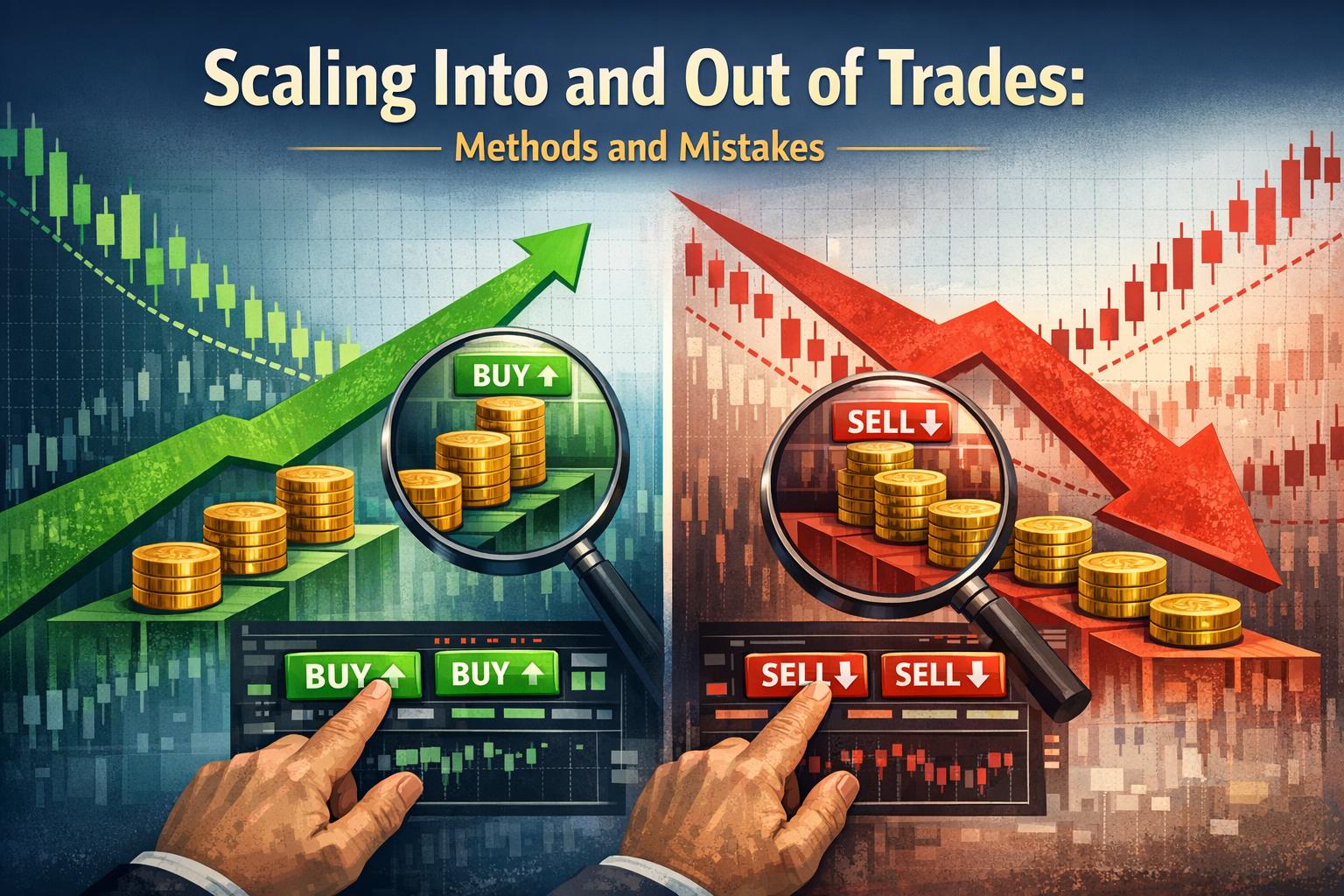
Scaling into and out of trades is a structured method of managing position size over time rather than executing a single, full-sized transaction. Instead of committing all capital at one price level, a trader divides the total intended position into smaller portions and deploys them sequentially. This approach applies to both entering and exiting trades and is widely used across asset classes, including equities, forex, commodities, and derivatives.
In practical terms, scaling recognizes that markets rarely move in perfectly predictable patterns. Prices fluctuate due to liquidity shifts, macroeconomic releases, technical factors, and changes in market sentiment. By distributing entries and exits across multiple price points, traders attempt to reduce the impact of short-term volatility while maintaining exposure to potential long-term movement.
Scaling is particularly relevant in environments characterized by uncertainty. When future price direction cannot be determined with high confidence, gradual positioning allows traders to observe how the market behaves after their initial entry. Instead of treating entry and exit as single events, scaling frames them as processes. This shift from single execution to phased execution provides both strategic and operational advantages.
Benefits of Scaling
The primary advantage of scaling is improved control over exposure. Rather than relying on precise timing, which can be difficult even with sophisticated analysis, traders can refine their average entry or exit price over several transactions. This often results in a more balanced cost basis, especially in fluctuating markets.
Another benefit lies in reducing execution risk. Entering or exiting a large position in one trade may cause unfavorable price movement due to slippage, particularly in less liquid markets. Gradual allocation minimizes the market impact of each order. This can be relevant for institutional traders as well as retail participants operating in lower-volume securities.
Scaling also introduces structural discipline. By defining in advance how much capital will be allocated at certain price intervals or technical levels, traders create a rules-based framework. This can reduce impulsive reactions and promote consistency. When implemented with predefined criteria, scaling becomes an extension of a broader trading plan rather than an improvised adjustment.
Risk Management
At its core, scaling functions as a risk distribution technique. When a trader scales into a position, capital exposure increases incrementally. If the market moves against the initial entry, the trader retains unused capital and may choose to deploy it at more favorable prices. This method reduces the probability of committing maximum exposure at an unfavorable level.
For example, if a trader intends to invest $10,000 in a stock, allocating the entire amount at once exposes the full sum to immediate price fluctuations. In contrast, dividing the capital into five $2,000 increments spreads timing risk. If the price declines after the first allocation, subsequent purchases may occur at lower levels, adjusting the overall cost basis.
Scaling out serves a similar protective purpose. By gradually reducing exposure as a price moves favorably, traders can lock in partial profits while preserving upside potential. This technique reduces the dependency on identifying the exact market top. Risk is systematically reduced as gains accumulate.
However, effective risk management through scaling requires predefined limits. Traders typically determine maximum total exposure and acceptable drawdown levels before initiating the strategy. Without these boundaries, incremental additions can evolve into overexposure, particularly in declining markets.
Enhanced Flexibility
Flexibility is another defining characteristic of scaling. Markets frequently produce mixed signals. An asset may begin trending in one direction only to reverse abruptly. Scaling allows traders to adjust participation levels in response to evolving conditions.
If an initial position begins to move in the anticipated direction, traders may complete their planned allocations, reinforcing exposure as confirmation strengthens. Conversely, if the market shows signs of structural weakness, they may suspend additional entries. In this way, scaling acts as a feedback-sensitive mechanism.
This flexibility also extends to trade management after entry. For instance, if price action accelerates faster than expected, a trader scaling out may accelerate the pace of exits. Alternatively, if momentum remains strong, exit intervals may be extended to capture additional movement. The incremental nature of scaling accommodates these adjustments without abandoning the overall strategy.
Methods of Scaling
Scaling techniques can vary depending on trading style, time horizon, and analytical framework. Some traders rely on technical levels to determine allocation points, while others use time-based intervals or volatility thresholds. Regardless of method, the fundamental premise remains the same: positions are constructed and unwound progressively.
Scaling Into Trades
Scaling into trades can be performed in several structured ways. A common approach involves allocating capital at predetermined price intervals. For example, a trader might purchase equal portions each time an asset declines by a fixed percentage. This method systematically lowers the average entry price during pullbacks.
Another approach relies on technical analysis. Traders may divide entries across support levels, moving averages, or retracement zones. If an asset retraces to a key level and holds, an initial allocation is made. If it moves to a deeper support area, additional units are added. Each step is contingent on predefined signals rather than discretionary reaction.
Time-based scaling is also common, particularly among long-term investors. Instead of targeting specific price movements, capital is deployed at regular intervals. This technique resembles dollar-cost averaging, where investments are distributed across consistent time periods regardless of price. Over time, this smooths the impact of volatility and reduces reliance on short-term market timing.
While scaling into weakening markets can lower the average cost basis, it requires careful evaluation. Adding to losing positions without clear structural justification may compound losses. Effective scaling depends on distinguishing between temporary price fluctuations and broader trend reversals. Traders often incorporate confirmation indicators to validate continued participation.
Scaling Out of Trades
Scaling out applies the same incremental concept in reverse. Rather than attempting to sell an entire position at a single target, traders break the exit into stages. This method allows partial realization of gains while maintaining exposure to potential continuation.
One structured technique involves predefined profit targets. For example, a trader may exit one-third of a position after a five percent gain, another third after ten percent, and hold the remainder with a trailing stop. This approach locks in progressive gains and reduces overall risk as the trade develops.
Trailing mechanisms can also be integrated with scaling out. As price advances, partial positions are sold while stop levels are adjusted upward for remaining units. This dynamic approach aims to balance capital preservation with participation in trending movements.
Scaling out may also be applied defensively. If market conditions deteriorate, traders might reduce exposure incrementally rather than liquidating immediately. This gradual exit can prevent overreaction to short-term volatility while still decreasing risk.
Market Conditions and Scaling Effectiveness
The effectiveness of scaling depends partly on market structure. In highly volatile environments, phased entries and exits can buffer against sharp fluctuations. Large price swings provide multiple opportunities for incremental positioning.
In trending markets, scaling into strength may enhance returns if additional allocations are made following confirmation signals. However, in strong directional moves, delaying full entry may result in a higher average price than a single early allocation. Therefore, traders must balance reduced timing risk against potential opportunity cost.
In range-bound markets, scaling can be particularly useful. When prices oscillate between support and resistance, traders can accumulate near lower boundaries and scale out near upper boundaries. The repetitive nature of range behavior aligns well with incremental strategies.
Liquidity also influences outcomes. In markets with limited depth, large single orders can distort prices. Scaling mitigates this issue by dividing transactions into smaller orders, reducing slippage and improving average execution.
Psychological Considerations
Although scaling is primarily a structural strategy, it also influences trader behavior. Committing full capital at a single price level may intensify pressure, especially if the market moves immediately against the position. Incremental exposure can moderate this effect by reducing the perceived urgency of short-term fluctuations.
Gradual exits similarly moderate decision-making tension. Rather than searching for the exact peak, traders follow predefined stages. This reduces dependence on precise forecasting and allows decisions to be guided by established criteria.
However, scaling does not eliminate psychological challenges. Adding to positions during market declines may increase stress, particularly if uncertainty about trend direction grows. Likewise, scaling out too early can generate concerns about missed gains. Successful implementation therefore requires adherence to predetermined allocation logic rather than reactive adjustments.
Common Mistakes in Scaling
While scaling offers structural benefits, improper execution can undermine its purpose. One frequent issue is applying a rigid plan without regard to evolving market evidence. Markets are dynamic systems influenced by new information. If fundamental or technical conditions change significantly, continuing to follow the original scaling schedule may expose capital unnecessarily.
Another mistake involves over-complication. Some traders establish excessive entry tiers, multiple conditional triggers, and overlapping indicators. This complexity can delay decision-making and obscure core strategy objectives. Clear allocation steps and measurable criteria are generally more reliable than intricate rule systems that are difficult to implement consistently.
Inadequate position sizing is a particularly significant concern. Scaling does not compensate for excessive total exposure. If the combined position ultimately exceeds acceptable risk limits, dividing it into increments provides limited protection. Proper calibration begins with defining total allowable risk before determining incremental structure.
Additionally, transaction costs must be considered. Frequent buying and selling increases commissions and spreads. If increments are too small relative to trading costs, profitability may decline. Effective scaling accounts for execution expenses within its design.
Strategic Integration with Broader Trading Plans
Scaling is most effective when integrated into a comprehensive trading framework. It should align with defined objectives, time horizons, and analytical methods. For short-term traders, incremental entries may occur within minutes or hours based on intraday volatility. Long-term investors may deploy scaling over months in response to macroeconomic trends.
Stop-loss placement also requires coordination. Traders often determine whether each increment carries its own stop level or whether the entire aggregated position shares a unified threshold. A unified stop simplifies management but may expose later entries to tighter constraints. Separate stops provide precision but increase complexity.
Capital allocation models frequently incorporate scaling as a core component. Portfolio managers may distribute capital across sectors incrementally to manage exposure to macroeconomic cycles. This reflects the broader principle that scaling extends beyond individual trades and can influence portfolio-level risk distribution.
Conclusion
Scaling into and out of trades represents a structured method of managing exposure through incremental position adjustments. By dividing entries and exits into multiple stages, traders can reduce timing risk, moderate volatility impact, and improve flexibility in dynamic market conditions. Effective implementation requires clear allocation rules, well-defined total risk parameters, and awareness of transaction costs.
When integrated within a disciplined trading plan, scaling serves as both a risk management tool and an adaptive execution strategy. Its effectiveness depends not only on market conditions but also on consistency in application and alignment with broader investment objectives.
This article was last updated on: June 25, 2026