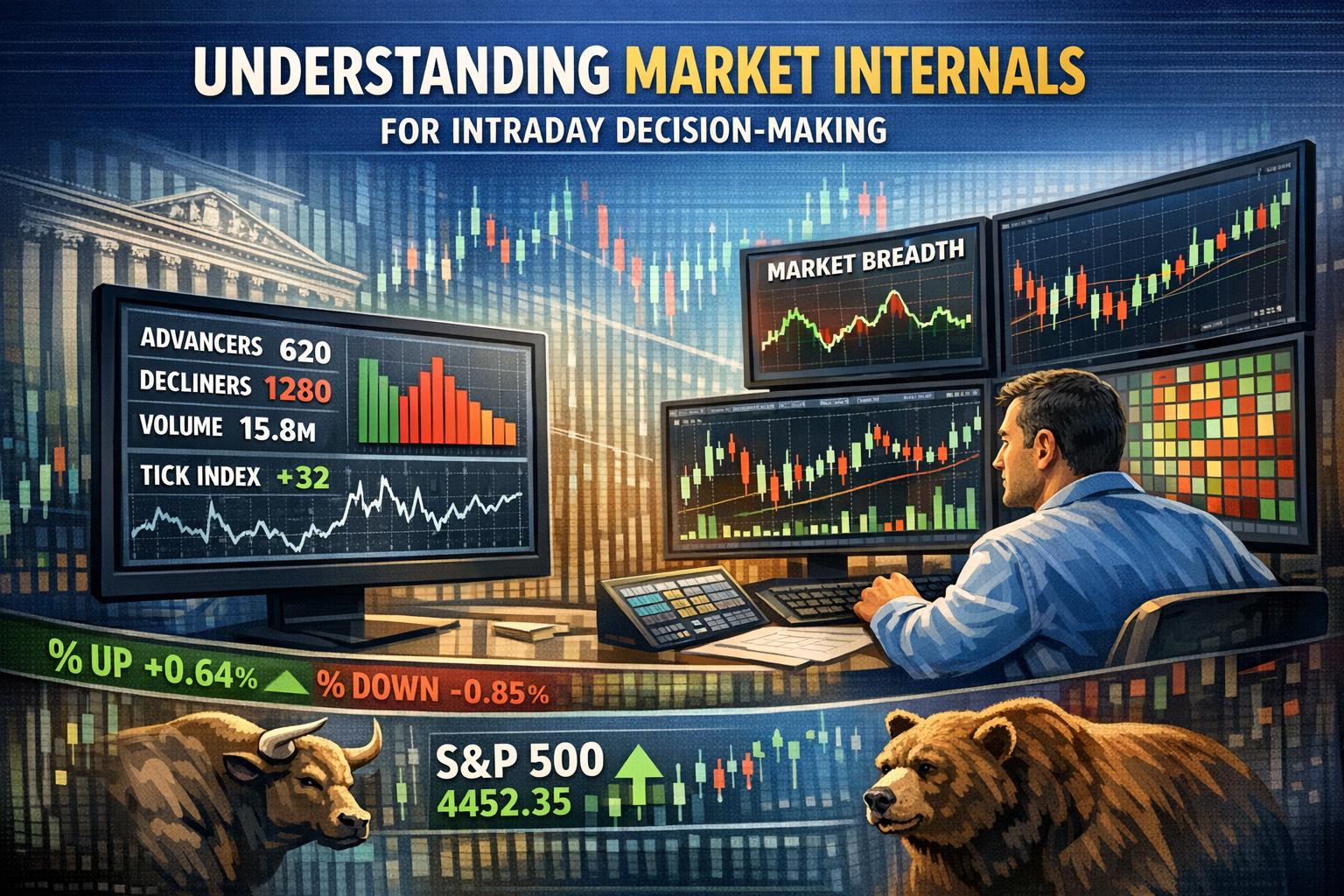
Understanding Market Internals for Intraday Decision-Making
Understanding Market Internals for Intraday Decision-Making
In the world of trading, understanding market internals is essential for making structured and informed intraday decisions. Market internals refer to a group of indicators that measure the internal strength, participation, and sentiment of a financial market. While price charts reflect the visible outcome of buying and selling activity, market internals offer insight into the underlying forces driving those movements. For intraday traders who operate within compressed time frames, this additional layer of information can improve timing, filter false signals, and clarify whether price action is supported by broad participation.
Intraday trading demands precision. Price fluctuations that appear significant on lower time frames may lack institutional backing or broader participation. Market internals help traders determine whether a move is supported by a substantial portion of the market or driven by isolated stocks or sectors. When used systematically, these indicators provide context that enhances trade selection, position sizing, and risk management.
Key Components of Market Internals
1. Advancers vs. Decliners
One of the primary measures of market breadth is the number of advancing stocks compared to declining stocks within an exchange. This relationship, often referred to as the advance-decline ratio, reveals whether buying or selling pressure is widespread. When the number of advancing stocks significantly exceeds decliners, the market is considered to have strong breadth. Conversely, if decliners dominate, the broader tone of the market is weak.
For intraday traders, this distinction is critical. A stock index may rise modestly, but if the majority of stocks are declining, the upward move may be concentrated in a small number of heavily weighted components. Such moves can lack durability. On the other hand, when price increases align with strong breadth, the advance is generally more stable.
Monitoring breadth throughout the trading session can also help traders detect shifts in sentiment. An early rally accompanied by strong breadth that gradually weakens over the day may indicate declining participation and a potential reversal. Observing how breadth behaves during pullbacks can further clarify trend strength. If a pullback occurs while breadth remains relatively positive, the trend may remain intact.
2. Volume Analysis
Volume measures the number of shares traded during a specific period and serves as a confirmation tool for price movement. In intraday trading, volume analysis extends beyond observing increased or decreased activity. It involves recognizing how volume interacts with price levels, breakouts, consolidations, and reversals.
High volume accompanying a breakout above resistance often confirms buyer commitment. Conversely, a breakout on light volume may lack follow-through. During declines, rising volume can signal increased selling pressure, whereas decreasing volume during a pullback may indicate exhaustion of sellers.
Volume can also be studied in relation to market breadth. A strong move supported by expanding volume and positive advance-decline data generally reflects broad institutional participation. When volume expands but breadth remains narrow, the move may be limited to concentrated interest in specific sectors or large capitalization stocks.
Volume-based indicators translate raw turnover into more interpretable signals. By studying changes in cumulative volume throughout the session, traders gain an understanding of whether market participants are actively building positions or simply reacting to short-term volatility.
Additional Indicators
1. Tick Index
The Tick Index measures the difference between the number of stocks trading on an uptick and those trading on a downtick at a particular moment. An uptick occurs when a transaction takes place at a price higher than the previous trade, while a downtick reflects a lower transaction price. Because the Tick Index updates in real time, it is especially useful for short-term traders.
Positive tick readings suggest aggressiveness from buyers, while negative readings indicate increased selling activity. Extreme readings often appear during periods of panic buying or selling. Intraday traders monitor these extremes to identify potential exhaustion. For example, repeated extreme positive ticks without further price progress can indicate waning momentum.
The Tick Index is most effective when interpreted in context. Persistently positive readings during a market pullback often suggest underlying demand, which may support continuation of the primary trend. Persistent negative readings, especially near resistance, may signal distribution.
2. Put/Call Ratios
The put/call ratio compares the trading volume of put options to call options. Because puts are commonly associated with downside protection or bearish speculation, and calls with bullish positioning, this ratio reflects prevailing sentiment in the options market.
A rising put/call ratio suggests increased demand for downside protection, often interpreted as growing caution. A declining ratio indicates stronger demand for calls and potentially increasing bullish sentiment. For intraday traders, shifts in the ratio during the session can signal changes in expectations.
However, interpretation requires nuance. Extremely high bearish sentiment can precede short-term reversals if excessive protective positioning creates conditions for short covering. Likewise, very low ratios implying excessive optimism can precede temporary declines. In intraday decision-making, the put/call ratio is typically used as a contextual indicator rather than a primary trading signal.
Market Breadth Indicators Beyond the Basics
Beyond advancers and decliners, traders often examine derived breadth indicators that transform raw data into trend-following or momentum-based measures. Cumulative advance-decline lines track the net difference between advancing and declining stocks over time, offering a long-term gauge of participation. During intraday trading, observing how this cumulative line behaves relative to price can highlight divergences.
For instance, if an index reaches a new high but the cumulative breadth measure fails to confirm, participation may be narrowing. In contrast, if breadth strengthens ahead of price, it may signal the potential for a delayed price breakout. Sector-level breadth is also relevant. Intraday traders frequently assess whether leadership is concentrated in defensive sectors or growth-oriented sectors, as this may signal broader risk appetite.
Another commonly tracked internal metric is new highs versus new lows within an exchange. A growing list of stocks reaching intraday highs can signal expansion of bullish participation. Conversely, an increasing number of intraday lows points to broad weakness. The interaction between these metrics and index price levels often provides insight into trend sustainability.
Volatility Measures and Intraday Context
While not traditionally grouped with breadth data, volatility indices contribute to understanding market internals. Volatility reflects expectations of future price fluctuations and is influenced by options pricing. Rapid increases in intraday volatility often coincide with elevated tick readings and broad declines.
For intraday traders, volatility acts as both an opportunity and a risk factor. High volatility environments may offer larger price swings but also require tighter risk controls. Market internals help distinguish between orderly volatility driven by balanced participation and unstable volatility accompanied by erratic breadth and extreme tick values.
Monitoring volatility alongside breadth creates a more complete picture. A moderately rising volatility index with neutral breadth may indicate healthy price rotation. Sharp volatility spikes combined with widespread decliners often reflect stress conditions.
Utilizing Market Internals in Trading Strategies
Integrating market internals into intraday strategies enhances analytical depth. Rather than relying solely on chart patterns or technical oscillators, traders can validate those signals against participation data.
Trend Confirmation occurs when price breakouts align with expanding volume, positive breadth, and constructive tick readings. For example, if an index breaks above intraday resistance while advancers outnumber decliners by a significant margin and tick values remain consistently positive, the breakout carries stronger statistical backing.
Identifying Reversals frequently involves recognizing divergence. Divergence occurs when price continues in one direction while internals weaken. If an index makes successive higher highs but breadth progressively declines, fewer stocks are contributing to the rally. Such narrowing participation can precede pullbacks. Intraday reversals often become more probable when divergence aligns with resistance levels and declining tick momentum.
Volatility Assessment supports tactical adjustments. In calm sessions characterized by balanced breadth and moderate tick readings, range-based strategies may perform well. In contrast, sessions marked by extreme breadth imbalances and persistent tick extremes may favor trend-following approaches.
Institutional Activity and Liquidity Considerations
Market internals also reveal clues about institutional behavior. Large institutions typically execute trades across multiple stocks and sectors. Therefore, broad-based strength supported by increasing volume and positive breadth often suggests institutional accumulation. Narrow, low-volume moves may reflect retail-driven or short-covering activity.
Liquidity conditions can change intraday, particularly around scheduled economic releases or major news events. Observing how market internals respond to such events is informative. A news-driven price spike accompanied by expanding breadth and sustained tick strength often indicates durable positioning. A spike with limited participation may fade once initial reactions subside.
Pre-market and post-market analysis of futures breadth and overnight sentiment can also provide context for the opening session. Opening imbalances between advancers and decliners frequently set the tone for early momentum trades.
Implementing Market Internals into Your Routine
Successful integration of market internals requires consistency. Traders typically position breadth data, tick readings, and volume measures alongside price charts on their trading screens. Observing these metrics in real time builds familiarity with typical patterns and anomalies.
Regular monitoring involves noting how internals behave during key moments, such as opening ranges, midday consolidations, and closing auctions. Patterns often repeat. For example, persistent breadth strength during midday consolidation may foreshadow afternoon continuation.
Using market internals in conjunction with other analysis methods strengthens decision-making. Technical analysis can provide entry and exit points, while fundamentals may explain broader themes. Internals then serve as confirmation. When all three align, confidence in the trade structure increases.
Contextual adaptation is essential. Not every trading day exhibits strong trends. On range-bound days, breadth may fluctuate around neutral levels. Attempting to interpret normal fluctuations as actionable signals can lead to overtrading. Understanding typical baseline readings for specific markets enhances accuracy.
Recording observations in a trading journal helps refine interpretation. Documenting how internals behaved during successful and unsuccessful trades creates a personal reference database. Over time, traders identify which combinations of signals align best with their strategies.
Conclusion
Market internals provide a structured framework for interpreting the forces beneath price action. By tracking breadth, volume, tick data, options sentiment, and volatility, intraday traders gain insight into participation levels and momentum quality. These metrics help confirm trends, identify divergences, and assess risk conditions within the trading session.
While no indicator guarantees outcomes, combining market internals with disciplined trade management enhances analytical depth. Price movement reveals what the market is doing, but market internals help explain how and why those movements occur. Incorporating this information into routine analysis supports more informed intraday decision-making and contributes to consistent evaluation of market conditions.
This article was last updated on: June 1, 2026